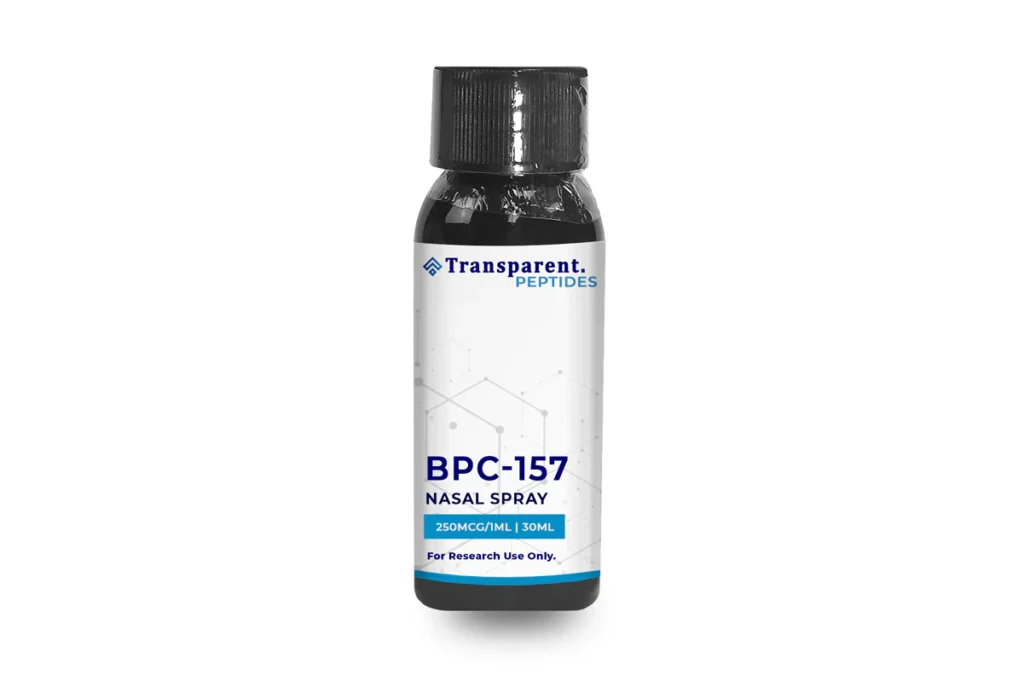
Quick answer: TB-500 nasal spray and BPC-157 nasal spray are ready-to-use liquid research formats. The TB500 Nasal Spray is a 30ml bottle containing 15mg of TB-500, and the BPC-157 and TB-500 Nasal Spray contains 15mg of each peptide in 30ml; a single-compound BPC 157 Nasal Spray is also listed. Compared with lyophilized powder, a nasal spray is supplied without a reconstitution step; compared with oral capsules, intranasal delivery is studied as a route that avoids digestive degradation. Published data on intranasal BPC-157 and TB-500 is limited and preclinical, and no efficacy has been established. For laboratory research use only; not for human consumption.
In peptide research, the delivery format is an important experimental variable that can affect stability and bioavailability. Here is how nasal formulations of BPC-157 and TB-500 compare with oral, topical and injectable formats in the research literature.
Product referenced: the BPC-157 and TB-500 Nasal Spray is a 30ml bottle containing 15mg of BPC-157 and 15mg of TB-500 as a liquid research solution. For laboratory research use only; not for human consumption.
BPC-157 and TB-500 nasal spray: specifications at a glance
- Listed item: BPC-157 and TB-500 Nasal Spray, a 30ml bottle containing 15mg of BPC-157 and 15mg of TB-500 as a liquid research solution.
- Format: ready-to-use liquid supplied without a reconstitution step.
- Storage: refrigerated at 2–8°C, protected from light; do not freeze; keep tightly capped between uses.
- Documentation: certificate of analysis (COA) available on request for research records.
- Shipping: United States and Canada.
- Status: laboratory research use only; not for human or veterinary consumption.
Nasal spray vs oral, topical and injectable-grade formats
The table summarizes how the four BPC-157 and TB-500 research formats differ in laboratory handling and in the points researchers weigh when planning a study.
| Format | Laboratory handling | Main research consideration |
|---|---|---|
| Nasal spray (liquid) | Ready-to-use solution; stored refrigerated at 2–8°C | Intranasal delivery is studied as a non-parenteral route; stability in solution |
| Oral capsules | Solid capsule format | Exposure to digestive degradation can lower bioavailability |
| Topical gel | Semi-solid format | Localized application; skin penetration is a key limitation |
| Lyophilized (injectable-grade) powder | Requires reconstitution under the investigator’s laboratory protocol | Parenteral routes generally show the highest bioavailability in the pharmacokinetic literature |
Nasal spray formulation
- Absorption: Intranasal delivery is studied as a route that bypasses the digestive system, avoiding degradation by stomach acid and enzymes.
- Non-Parenteral: Nasal formulations are researched as a non-parenteral alternative to injectable formats.
- Handling: Supplied ready to use, without a reconstitution step.
Oral formulations
- Digestive Degradation: Orally delivered peptides are exposed to the digestive process, which can degrade them and lower bioavailability.
- Research Considerations: Because most peptides are broken down by stomach acid, oral formats are typically studied for comparison with other routes.
Topical formulations
- Localized Delivery: Topical formats are studied for localized effects at the application site rather than systemic distribution.
- Penetration Limits: Skin penetration is a key limitation investigated in topical peptide research.
Lyophilized (injectable-grade) formats
- Bioavailability: Parenteral routes generally show the highest bioavailability in the pharmacokinetic literature.
- Laboratory Handling: Lyophilized peptides require reconstitution and sterile laboratory technique under the investigator’s protocols.
How intranasal peptide delivery is studied in research
Intranasal delivery is a recognized route in pharmaceutical research. Papers on nasal peptide delivery typically discuss four variables: the thin, well-vascularized nasal epithelium; mucociliary clearance, which limits how long a solution stays in contact with the mucosa; enzymatic degradation by peptidases in the nasal cavity; and molecular size, since larger peptides cross the epithelium less readily. Formulation factors such as pH, osmolarity and preservatives are therefore part of study design when a nasal spray is compared with other formats.
Evidence status of BPC-157 and TB-500 nasal sprays
Published work on BPC-157 and TB-500 is largely preclinical (cell-culture and animal models), and data on intranasal delivery of these two specific peptides is limited. Neither peptide is approved by the FDA as a drug, and no efficacy or suitability for human use has been established. This comparison is intended for laboratory planning only and makes no performance claims.
Storage and handling of research nasal sprays
Store the sealed bottle refrigerated at 2–8°C, protected from light. Do not freeze, and keep the bottle tightly capped between uses. Handle with gloves and standard laboratory eye protection, keep out of reach of children and untrained personnel, and follow your institution’s SOPs. A COA is available on request for research records.
BPC-157 nasal spray, TB-500 nasal spray and the blend
Three liquid nasal spray listings are available for laboratory research, each a 30ml bottle:
- BPC-157 Nasal Spray: 15mg of BPC-157 in solution.
- TB-500 Nasal Spray: 15mg of TB-500 in solution.
- BPC-157 and TB-500 Nasal Spray: 15mg of BPC-157 and 15mg of TB-500 in solution.
Single-compound TB-500 is also listed for laboratory research as TB-500 10mg (one vial, 10mg lyophilized powder) and TB-500 Capsules (bottle of 30 capsules, 200mcg each). Research use only.
FAQ
Why does peptide delivery format matter in research?
In peptide research, the delivery format is an important experimental variable that can affect stability and bioavailability.
How do nasal formulations compare with oral formulations?
Intranasal delivery is studied as a route that bypasses the digestive system, avoiding degradation by stomach acid and enzymes. Orally delivered peptides are exposed to the digestive process, which can degrade them and lower bioavailability.
What are the limits of topical peptide formats?
Topical formats are studied for localized effects at the application site rather than systemic distribution, and skin penetration is a key limitation investigated in topical peptide research.
Which BPC-157 and TB-500 formats are listed for research?
Nasal spray, capsule, topical and lyophilized BPC-157/TB-500 formats are listed, along with single-compound TB-500 10mg (one vial) and TB-500 Capsules (30 x 200mcg), all for laboratory research use only.
Is there a TB-500 nasal spray?
Yes. TB500 Nasal Spray is listed as a 30ml bottle containing 15mg of TB-500 as a liquid research solution, alongside a BPC-157 nasal spray and a BPC-157 and TB-500 blend nasal spray. All are for laboratory research use only.
How does a nasal spray differ from a lyophilized research format?
A nasal spray is supplied as a ready-to-use liquid, while lyophilized powder requires reconstitution under the investigator’s laboratory protocol. In the pharmacokinetic literature, parenteral routes generally show the highest bioavailability, so format is considered an experimental variable.
What does the research literature say about BPC-157 and TB-500 nasal sprays?
Published work on BPC-157 and TB-500 is largely preclinical, and data on intranasal delivery of these two peptides is limited. No efficacy or suitability for human use has been established, and we make no performance claims.
How should a research nasal spray be stored?
Store the sealed bottle refrigerated at 2–8°C, protected from light. Do not freeze, and keep it tightly capped between uses. Follow your institution’s SOPs.
All products referenced are sold strictly for laboratory research use only and are not for human or veterinary consumption.